A Paper Scrap, a Sticky Note or a Shared Document
A paper scrap, sticky note or shared document can keep ideas visible in different ways; choose the format that fits how a group will revisit them.
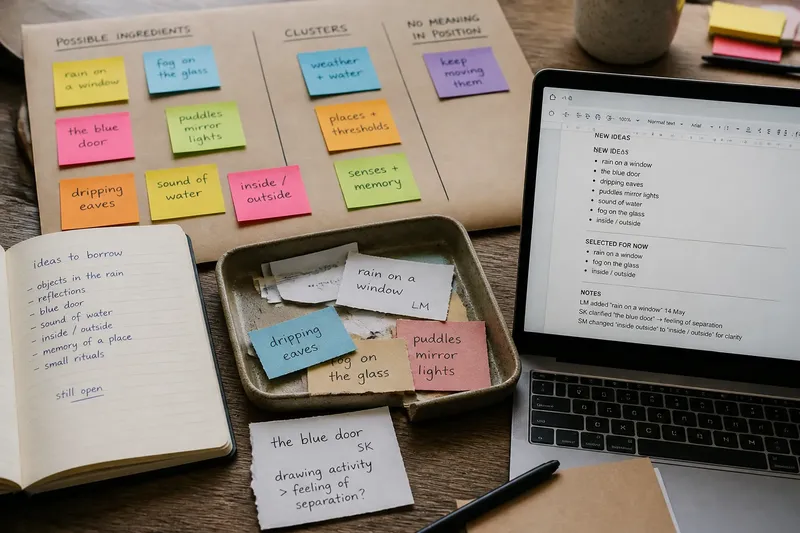
A paper scrap, sticky note or shared document changes which ideas stay visible after a creative activity begins. Personal lists and collaborative writing tools both collect possibilities, but they differ in who can add to them, how long they remain in view and what happens when the group moves on.
The trouble usually starts when a material is expected to do several jobs at once. A note can hold an idea, mark a decision and prompt a later action, but it may not do all three clearly. Choosing the format by its visible limits, rather than by its novelty, helps a collection remain useful.
A private list can become a collection no one else can enter
Personal lists are easy to start because their writer controls the wording, order and pace. A person can jot down fragments on a receipt, in a notebook or on the back of an envelope without asking anyone to join in. That privacy can make tentative ideas easier to record.
The same feature becomes a problem when the list is meant to support shared making. Others may see only a selection, or encounter the list after its writer has already decided what matters. The collection then looks finished even if it began as a place for possibilities.
Try making the list’s status visible. Add a short note such as “ideas to borrow” or “still open” at the top, and leave space for additions if other people will use it. If the list is intentionally personal, say so; a private record need not pretend to be a group resource.
For a group activity, choose one list owner only when someone needs to keep the collection legible, not to approve every contribution. The owner can preserve wording while the group decides what to use.
A scrap of paper can vanish before its idea gets a turn
Loose paper is a low-friction place to catch a thought. It needs no login, charged device or special layout, and a small scrap can travel from kitchen table to workshop wall. Its weakness is equally plain: it has no built-in address, and its edges do not announce where it belongs.
Scraps get lost when they are separated from the activity that gave them meaning. A phrase like “the blue door” may be vivid to the person who wrote it and opaque to everyone else once the conversation has moved on. The cause is not poor handwriting alone; the note lacks enough context to be picked up later.
Try adding a few anchoring words: the activity name, a contributor’s initials if useful, or a nearby question the phrase answers. Keep the note beside the related materials rather than moving it to a general pile. If the group needs to sort many slips, use a tray or envelope marked with the activity name.
Say a group is collecting ideas for a shared drawing and someone writes “rain on a window.” If that scrap is tucked beside the drawing paper, the image remains easy to connect to the activity; left on a crowded table, it may look like an unrelated reminder. A small amount of context and a deliberate landing place do more than elegant stationery.
A sticky note can make a temporary idea look settled
Sticky notes make separate contributions visible at once. People can place them near one another, move them into rough clusters or leave them apart without rewriting a list. That physical arrangement turns a wall, tabletop or window into a working surface.
The trouble begins when position starts to imply more than the group intended. A note placed at the top may look selected; one left at the edge may seem rejected. Adhesive also has a short, undramatic career: notes can curl, slip or detach, especially when the surface is dusty or repeatedly handled.
Try naming the stage of the collection before arranging it. “Possible ingredients” gives notes room to remain tentative; “chosen ingredients” signals a decision. If placement has no meaning, say that too, so the wall does not quietly become a voting system.
For ideas that must remain visible beyond the session, photograph the arrangement or transfer the wording to a durable record. Keep the notes available until the group agrees the record is complete. Otherwise, the photo may preserve the shape of a decision that nobody remembers making.
A shared document can keep a long list visible but hide who shaped it
A shared document is useful when contributors are not in the same room or when a collection needs to persist between sessions. It can hold longer phrases than a sticky note, preserve an evolving list and let people return without carrying paper. A plain document is often enough; elaborate boards can add controls before the group has a reason to use them.
Its particular weakness is that a single scrolling page can make the present state hard to read. New ideas, edits and decisions may blend together, while a polished heading makes an unfinished collection look official. The document keeps text accessible, but visibility still depends on how it is arranged.
Try separating “new ideas” from “selected for now” with simple headings. Put recent additions where contributors can find them, and leave a short note when wording has been changed for clarity. If the group wants a record of original contributions, preserve them rather than silently replacing them with a smoothed-out version.
Use a shared document when the group needs ongoing access, searchable wording or contributions at different times. Use paper when the point is to see and move ideas together in one place. Neither format is automatically more collaborative: access settings, shared devices and the group’s comfort with typing all affect who can take part.
Choosing where ideas stay visible depends on the next use
A collection can be easy to create and still fail at the moment someone needs to use it. Ask what should happen to the ideas next: will people browse them during a conversation, return to them later, or carry one into another activity? The answer points toward a material without requiring a complicated system.
- Use a personal list when one person is collecting thoughts before inviting others in, or when private drafting is part of the activity.
- Use loose scraps when contributors need a quick, unstructured way to offer short ideas without sharing a device.
- Use sticky notes when the group needs to compare, cluster or rearrange contributions in the same physical space.
- Use a shared document when people need to add or revisit wording at different times, or when the collection must remain available between gatherings.
- Use a paired record when a physical arrangement helps the group think but the wording also needs to survive after the room is cleared.
The paired option does not require copying every mark. A quick typed index or photograph can preserve the useful shape of the collection, while the original stays on the table for the activity. Choose what needs to remain visible, not what can be archived merely because a device is nearby.
Why do ideas disappear or become hard to use?
Why does a list feel closed to new contributions?
It may have a finished title, a single visible author or no place for additions. Mark it as open, invite people to append ideas, or keep it personal rather than presenting it as a shared collection.
Why do sticky notes get mistaken for votes?
People often infer meaning from position, grouping or a visible count. State whether the arrangement is for sorting, selection or simply keeping items in view, and use a separate clear signal for any decision.
Why does a shared document feel difficult to enter?
Contributors may not know where to write, what can be edited or whether rough wording is welcome. Add a short instruction at the top and a clearly marked place for new ideas; keep the page simple enough that the invitation is visible.
Why does a saved collection stop being useful?
It may preserve words without preserving their context or current status. Add a brief note about what the collection is for and whether items are possibilities, selections or reminders, then place it where the group will look again.
Keep the record useful without making it a monument
Collecting ideas does not require every fragment to become permanent. A personal list can remain private, a sticky note can serve its moment and a shared document can be edited when the group’s needs change. The useful distinction is whether people can tell what they are looking at and what they are invited to do with it.
For a simple handoff, preserve the wording that matters, label the collection’s status and give it a place the next contributor can find. A paper scrap, sticky note or shared document works best when its limits are visible too: that is how an informal record stays open to use without pretending to be the final word.