A Story Swap for a Rainy Afternoon
A story swap for a rainy afternoon turns spare paper and a few shared ideas into a playful group story, with a clear way to shape and finish it.
A story swap for a rainy afternoon can turn a mug, a strange sound and a sheet of paper into a story with several authors. Give the group a few ways to shape the plot, and the activity feels more like passing around a useful idea than taking turns at a microphone.
Choose a simple story engine
Start with a setup that creates a choice: someone finds an object where it does not belong, hears a noise from an empty room, or discovers that a familiar place has changed. A choice gives the next person something to build on without requiring a complete plot before anyone begins.
Write the setup at the top of a sheet of paper. Below it, leave room for characters, events and possible endings. Keep the premise open enough for a drawing or a surprising turn to count as a contribution.
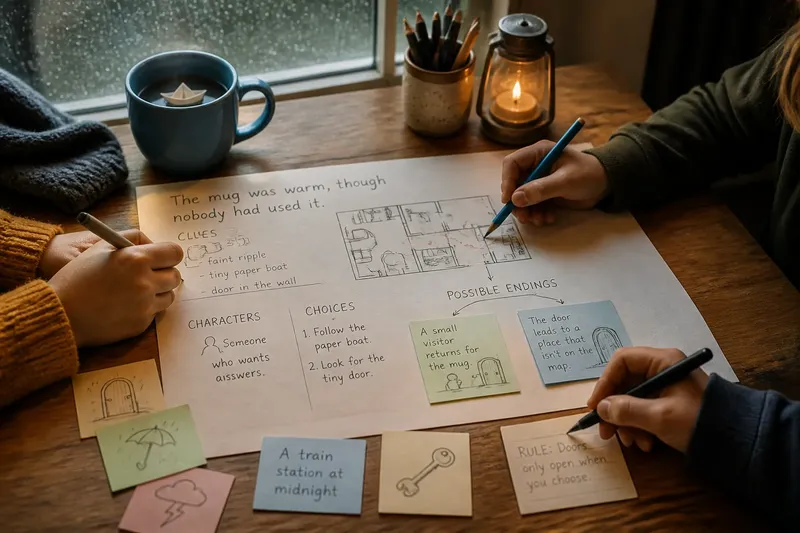
Say you have a table, a blue mug, a pencil and three people who want to make something but have no shared idea. One person writes, “The mug was warm, though nobody had used it”; the next draws a map of the room; the third adds that a tiny paper boat is floating inside. The group now has a character-free mystery to develop, and the drawing supplies a place for it to happen.
Give each contribution a job
A story can move forward through more than sentences. Offer a few distinct ways to add information, so the group can make choices about the story’s direction rather than merely taking turns writing.
- Add a clue: Write or draw a detail that could explain the opening event. If it suggests a new possibility, keep it; if it contradicts a detail the group wants to preserve, revise the clue or leave it out.
- Introduce a character: Add someone who wants something from the situation. If that desire gives the story a reason to move, include the character; if it makes the scene crowded, combine the character with someone already present.
- Change the setting: Move the action to a place that alters what can happen. If the new place creates a useful obstacle, use it; if it changes nothing, keep the original setting.
- Offer a choice: Write two possible actions for a character. If both lead to interesting consequences, let the group select one or keep both as branches; if one repeats an earlier event, replace it with a different action.
- Track a detail: Note a name, object or rule that should remain consistent. If the detail still matters, carry it forward; if it no longer helps the plot, mark it as optional rather than forcing it into every scene.
- Draw a story beat: Sketch a moment the group has already invented. If the image adds information or clarifies the action, leave it beside the text; if it introduces an incompatible event, ask whether to adapt the plot or keep the drawing as an alternate version.
These jobs can change as the story develops. A person who began with a map can later suggest an ending; the paper does not care about anyone’s official title.
Use a handoff that keeps the plot legible
For a written story, pass one page at a time and ask the next contributor to add a clue, complication or consequence. If a sentence is hard to read, the group can ask what it says without turning handwriting into a literary issue.
For a more playful structure, put separate ideas on slips of paper: one for a place, one for an object and one for an unexpected event. Arrange them in an order that makes a beginning and a complication, then add a final slip that changes how the earlier details fit together.
When the group has competing ideas, put both on the page before deciding. A short branch—“If the door opens, this happens; if it stays shut, that happens”—can preserve the disagreement as part of the story instead of making one person referee it.
Decide how to shape the ending
An ending need not explain every odd detail. It can resolve the main choice, reveal what an object was for, or stop at the moment a character decides what to do next. The useful question is whether the last scene changes the situation, not whether it ties every loose thread into a bow.
Say the mug story has accumulated three possible explanations: a neighbor left it, it arrived through a tiny door, or it belongs to someone who has not appeared. The group can keep the first two as clues and choose the third as the reveal: a small visitor returns for the mug just as the characters decide to follow the paper boat. That ending uses earlier details and gives the next scene a clear direction.
What story-swap questions come up?
How do you start when nobody has an idea?
Choose a familiar object and give it one unfamiliar quality, such as a warm mug in an empty room. Ask what could explain that detail, then write the first plausible answer on the page and let the next contribution complicate it.
Can a story swap work without a shared page?
Yes. Write each character, place or event on a separate slip, then move the slips around until the sequence suggests a story. This makes rearranging the plot easier, though someone will need to keep track of which details the group wants to retain.
How can a mixed-age group make one story?
Use concrete choices—where to go, what to open, which clue matters—alongside drawing and writing. Keep the story’s rules visible on the page, so a new idea can be compared with what the group has already established.
What if the ending is still disputed?
Keep two endings side by side and let each one follow from the same last scene. The result can be a pair of short versions rather than a vote that decides which person’s idea counts.
Leave a useful trace of the story
Before putting the pages away, mark the details the group may want to reuse: the opening event, an unresolved question and any character or object that still matters. If nobody wants to continue later, the marked page is still a finished piece of shared play, not a promise to convene a committee about the mug.
A story swap for a rainy afternoon works especially well when the page shows how ideas connect. Keep the clues, choices and alternate endings together, and the next person who picks it up can see not just what happened, but where the story could go.